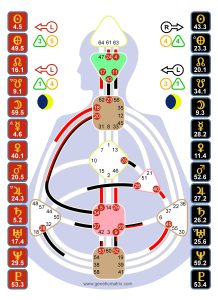
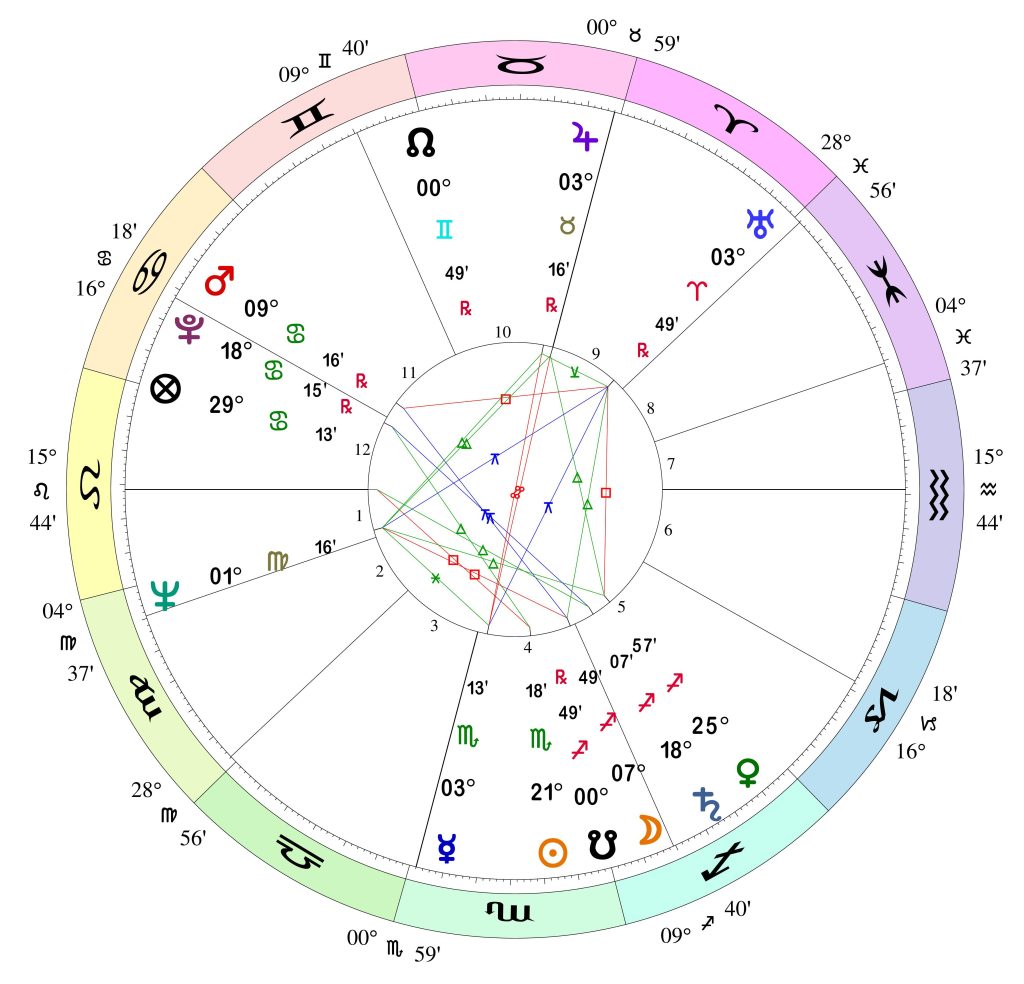
Image: Human Design and Astrology charts for Michel Gauquelin 1
I’ve been doing readings for over thirty years. In that time, I’ve sat with hundreds of people who arrive curious, a little confused, and almost always asking some version of the same question: “Wait — aren’t these the same thing?”
They’re not. But I understand why it seems that way.
Both your astrology chart and your Human Design chart are drawn from the exact same moment, the positions of the planets at your birth. In that sense, they share the same sky. But what each system does with that sky is completely different.
Think of it this way: two painters in front of the same mountain. Same mountain, same light, same afternoon. But one paints with watercolor, flowing and atmospheric, full of mood and meaning. The other uses architectural tools, precise, structured, designed to show the mountain’s internal construction.
That’s astrology and Human Design. Same sky. Entirely different languages.
Astrology: The Original Language of the Sky
Astrology is ancient. It’s the oldest symbolic language we have for exploring the connection between the movements of celestial bodies and the unfolding of human life.
In an astrology chart, the sky is shown as a wheel divided into twelve houses. Each house stands for a specific area of life: identity, money, communication, family, creativity, work, relationships, and more. Every planet in your chart is placed in a zodiac sign, a house, and forms aspects with other planets.
This is where astrology becomes fascinating. A planet symbolizes a function: Mars represents your drive and desire, Venus stands for your ability to love and appreciate beauty. The sign reveals how that function manifests itself. The house shows where in your life it is most prominent. And the aspects, or the angles between planets, indicate how these different parts of you communicate. Do they support each other, clash, or make up for one another?
Mars in Aries is very different from Mars in Pisces. Venus in the 10th house tells a different story than Venus in the 4th. That’s why I’ve never come across two charts that feel the same, even if they look similar on paper.
What astrology does brilliantly:
-
- Illuminates your psychological style and inner landscape
- Names your gifts, your recurring tensions, your growth edges
- Tracks the timing of your life and the seasons you’re moving through
- Explores relationship dynamics with depth and nuance
- Reveals your karmic and developmental themes
Astrology is both symbolic and temporal. It doesn’t just describe who you are. It shows you what kind of chapter you’re living through right now.
Human Design: The Map of Your Energetic Mechanics
Human Design appeared much more recently; it originated in 1987 and combines elements of astrology, the I Ching, the Kabbalistic Tree of Life, the Hindu-Brahmin chakra system, and quantum physics. It is truly a synthesis unlike anything that came before it.
Here’s how it differs from astrology: in Human Design, the planets don’t land in houses. Instead, they activate gates.
There are 64 gates in Human Design, corresponding with the 64 hexagrams of the I Ching. Each gate has its own energetic theme, and each is divided into six lines. As a result, every planetary placement in your chart is not only in a gate but also in a specific line of that gate, which further influences how it expresses itself.
But here’s what still excites me after all these years: it’s what happens between those gates that truly shapes your chart.
When two activated gates connect, they create a channel. Channels define centers, and the pattern of defined and undefined centers throughout your BodyGraph, the key diagram in Human Design, determines something no other system offers: your Type, your Strategy, and your Authority.
The Structural Difference That Changes Everything
In astrology, meaning arises through relationship, specifically through the angular relationships (aspects) between planets. Are your Sun and Moon in harmony? Is your Mercury squared by Saturn? These relationships are the heart of astrological interpretation.
In Human Design, meaning arises through mechanics. The system isn’t asking how the planets relate to each other symbolically. It’s asking: What is actually switched on? What channels are formed? What does that create in terms of how your energy works?
This is a fundamentally different question. And it produces fundamentally different answers.
Type, Strategy, and Authority: Human Design’s Unique Gift
Nothing in astrology quite corresponds to what Human Design offers through Type.
The BodyGraph categorizes everyone into one of five energy Types: Manifestor, Generator, Manifesting Generator, Projector, or Reflector. I’m a Projector, and when I first encountered that framework, something clicked into place that thirty years of astrological studies hadn’t quite achieved in the same way.
Type isn’t a personality category. It’s a description of how your energy is meant to function and how you’re designed to move through life. From Type, there’s Strategy, the specific way you’re built to engage with opportunities to experience less resistance and more flow. The chart’s internal setup reveals your Authority, showing how you’re wired to make accurate decisions.
When someone sits across from me, confused about why their good intentions keep causing friction, why they feel constantly exhausted, or why decisions that seemed right on paper keep falling apart, this framework quickly clarifies things. Because it’s not just theoretical; it’s practical.
Defined and Undefined Centers: Knowing Where You’re Solid and Where You’re Porous
This is another distinction that has no real equivalent in astrology, and one I constantly revisit in my practice.
In Human Design, each center in the BodyGraph is either defined (colored in) or undefined (open/white). Defined centers are where your energy is consistent: reliable, stable, yours. Undefined centers are where you’re naturally more receptive, more impressionable, and more prone to absorbing the energy of the people and environments around you.
This is critical for understanding conditioning, i.e., the patterns we absorb that don’t truly belong to us but that we begin to treat as our own. Astrology explains this through signs, houses, aspects, and sensitivity patterns. However, the defined/undefined framework in Human Design is immediate and visual, often leaving people stunned in the best possible way.
The Incarnation Cross: Your Life’s Central Theme
One of my favorite features unique to Human Design is the Incarnation Cross.
The Cross is formed from four placements: your Conscious Sun, your Conscious Earth, your Unconscious Sun, and your Unconscious Earth. Together, these four gates establish the central thematic architecture of your incarnation, the fundamental frequency your life is meant to carry.
It’s not a job title. It’s not a destiny script. It’s more like a tuning fork. When your life is in harmony with your Cross, there’s a sensed feeling of rightness, even in hard times. When you’re far from it, something always feels off.
Astrology doesn’t have a direct equivalent to the Incarnation Cross, but it offers many rich ways to explore life purpose and direction — through the Sun, the lunar nodes, the angles, the chart ruler, and various evolutionary and karmic signatures.
Both Systems Work with Timing — Just Differently
I want to be clear about something that often surprises people: both systems go far beyond the natal chart.
In astrology, timing is revealed through transits, progressions, solar returns, eclipses, and more. These tools show the changing seasons of a life: periods of growth, consolidation, pressure, awakening, loss, or creative breakthrough.
In Human Design, transiting planets also activate gates and channels in real time. A transit can temporarily define a center that’s usually open in your design or complete a channel that’s otherwise dormant. This is why you might feel unexpectedly energized on certain days, unusually emotional, or suddenly driven to act. Energies have moved through the global field and landed in your chart.
Both systems provide strong frameworks for understanding why a certain time in life feels a certain way. They might call that time differently. But they both follow the same movement of the sky.
How I Use Both Together
After decades of working with both systems, I don’t think in terms of either/or. I think in terms of what each one illuminates.
Astrology shows me:
-
- The psychological complexity and emotional landscape of a person
- Their karmic and developmental themes
- The timing and quality of the seasons they’re moving through
- The richness of the relational patterns in their life
Human Design shows me:
-
- The energetic structure they were born with
- How they’re wired to make decisions
- Their natural mode of engagement with life
- Where they’re consistent and where they’re open to conditioning
Astrology often explains why something matters so deeply to someone. Human Design often shows how they’re best designed to move with it.
Astrology describes the richness of a person’s inner world. Human Design shows the mechanics through which that world moves.
Together, and this is what I’ve based my practice on for thirty years, they can validate not only who you are but also how you work. And that combination? That’s where true transformation can happen.
A Final Word
If you’re new to both systems, I want to offer you this: don’t worry about mastering the technical details right away. Start with curiosity.
Both astrology and Human Design start with the same view of the sky and offer the same core invitation: to understand yourself more fully, to live more in sync with who you truly are, and to stop resisting your own nature.
One provides a symbolic portrait. The other offers a functional map. Together, they give you something rare and powerful: a way of seeing yourself that is both deeply true and immediately useful.
That’s what I’ve always been after. And if you’re here, I suspect you are too.
Want to go deeper?
Book a complete reading and decode your blueprint to bring clarity, direction, and power back to your life and business.
© | Gloria Constantin | All Rights Reserved |
Need help or have questions? Contact Me
____________________________________________
1 Michel Gauquelin (1928-1991) was a French psychologist and astrologer who, together with his wife, Françoise, also a psychologist, conducted rigorous research over a period of thirty years that demonstrated certain astrological phenomena held true to a high degree of statistical validity.