 Human Design, Loss, and the Practice of Being Human
I know what it feels like to stand in an arroyo at seven in the morning, screaming at God.
For three years straight, I did exactly that. I had lost my paralegal career to a layoff and my relationship to a man who needed to be “free” for Ireland. I had sold my home in Boulder, the house where I had loved, buried cats, and built friendships, and over thirty years had become someone who belonged somewhere. I had submitted three hundred résumés and received nothing. I had taken early Social Security to keep a roof over my head. I had landed in an Albuquerque apartment complex that didn’t allow pets, surrounded by abandoned cats living under cars and in drainage channels, while my neighbors destroyed my feeding stations and my savings continued to drain. Every morning, I stood in the arroyo’s garbage, fist raised, daring the universe to explain itself.
By the fourth year, I stopped screaming. Not because I had found peace, but because no deity seemed moved by my grievances, and I had, at last, wrung all I could from my indulgent remonstrances.
By then, I was also a Human Design practitioner. I knew my Type, Strategy, and Authority. I knew my open centers and the not-self patterns that had shaped my conditioning for decades. And I can tell you this honestly: none of that knowledge stopped the screaming. What it did, slowly and imperfectly over the years, was help me understand why I had been so completely swept away.
That is both the gift and the limitation of Human Design. Understanding the difference may be the most compassionate offering this system can make when life breaks you open.
What Human Design Is (and What It Isn’t)
Your Human Design chart is a map. It reveals your unique configuration of energies, how gates, channels, and centers interact, how your energy flows, and the overarching themes of your life. It gives you a compass for decision-making through Strategy and Authority. It offers language for the ways you’ve been conditioned to override your own knowing. It illuminates the open centers, the places in the chart where you absorb others’ energy and mistake it for your own. And it gently yet persistently asks you to stop letting the mind run the show.
But a map is not the territory. Your chart won’t tell you the extent of your talent or discipline. It doesn’t reveal your appearance, intelligence, upbringing, health, or the specific experiences that have shaped you. These are what you bring to the table, the living texture of a life no chart was designed to capture. Every element in the BodyGraph has a range within which it can express itself, and external factors, personal choices, and the sheer unpredictability of being alive all influence how each theme unfolds. No one, not even the most skilled analyst, can predict precisely how you will express your Design.
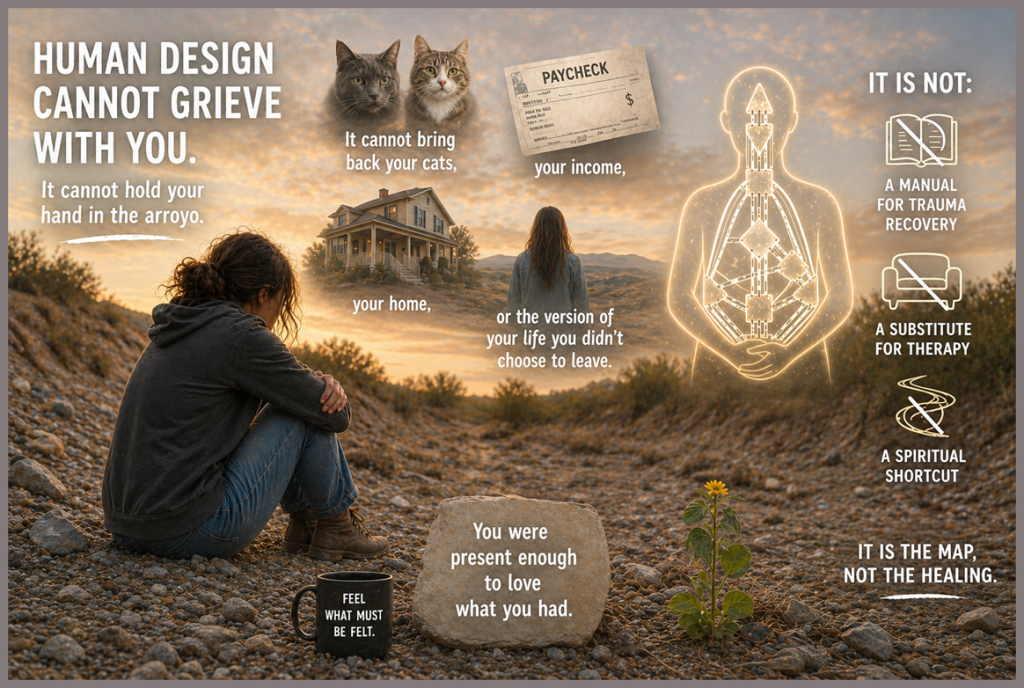
This matters enormously when you’re suffering. If Human Design cannot predict how your chart will express itself in the best of times, it certainly cannot account for what happens when grief, illness, or powerlessness reshapes the ground beneath you. It cannot hold your hand in the arroyo. It cannot bring back your cats, your income, your home, or the version of your life you didn’t choose to leave. It is not a manual for trauma recovery, a substitute for therapy, or a spiritual shortcut around the long, unglamorous work of feeling what must be felt.
The whole system is often distilled into a single instruction: follow your Strategy and Authority. But that really means keeping fear from driving your decisions. In a crisis, the mind accelerates into overdrive: fix it now, prove your worth, don’t feel it, extract meaning immediately. Strategy and Authority invite you to resist that acceleration and wait for clarity rather than act out of panic.
But waiting for clarity is nearly impossible when your nervous system is flooded. This is not a character flaw. This is what it means to be human with open centers.
Why “Just Follow Your Strategy” Can Feel Impossible in Grief
One of the most compassionate teachings in Human Design is this: when you spin under pressure, you are not weak. You are conditioned. Your open centers amplify everything around you, and grief turns up the volume on all of them at once.
I lived this. My open Root meant everything felt urgent: always find a job, save the cats, fix the apartment complex’s adversarial policies, solve the infrastructure problems, and don’t let anything slip. The open Head kept asking why: why did this happen, what does it mean, and what is the lesson? The open Will pushed me to overcommit, pushing far beyond what I could give, because somewhere inside I believed that if I worked hard enough, I could earn my way back to safety.
Understanding this didn’t ease the urgency, but it transformed shame into understanding. I wasn’t broken. I was running hot on borrowed energy, amplified, in a body that needed rest and tenderness.
And this is the distinction that separates useful Human Design from cruel Human Design: knowing your open centers gives you language for your suffering. It does not, by itself, give you the ability to stop suffering. That must come from support, care, and the slow accumulation of small acts of self-trust. Human Design can point you toward the door. You still have to walk through it, and on some days you’ll need someone to walk alongside you.
Correctness and Capacity
When life breaks you open, two realities run in parallel. There is the question of correctness: What is the right next step? What is the not-self trying to force? Which decisions can wait until the body settles? And there is the question of capacity: Can I breathe? Can I sleep? Can I eat? Do I have anyone to call?
Human Design speaks directly to correctness. Capacity is yours to tend, and it must be tended first.
The foundation everyone must have, regardless of Type or Profile, is vitality. Without it, nothing in your Design can function as intended. You cannot respond appropriately when you’re depleted. You cannot wait for an invitation when you’re running on fumes. You cannot communicate clearly when your body is in shock. And you certainly cannot honor the slow, lunar rhythm of reflection when the nervous system is screaming for immediate action. Without vitality, Strategy and Authority are instructions your body cannot execute.
This is where sincere students of Human Design sometimes wound themselves. They treat their devastation as evidence of misalignment. If I were truly following my Authority, I wouldn’t feel this powerless. If I were truly living my Design, this wouldn’t be happening to me. But pain isn’t proof that you’re doing it wrong. It’s proof that you loved and were actively engaged with your life.
And here is something no chart can answer for you: why some lives are more complex and more difficult than others. Karma, luck, choice, cultural forces, and external interference may all play a role, and we may never untangle how much was our own doing and how much was the hand we were dealt. Some people simply face more than others. That is not a reflection of their Design. It is a fact of being alive.
I loved Boulder. I loved my cats. I loved the work that gave my days structure and purpose. Losing them was supposed to hurt. The grief was not a malfunction. It was the appropriate response to a life that had truly mattered.
A Way Through
What helped me, not all at once or neatly but eventually, was learning to move through grief and powerlessness in a specific order.
First, tend the body. Before consulting any system, framework, or authority, inner or outer: drink water, eat something, take a walk, and place one hand on your chest to breathe. This may sound unremarkable, but that’s the point. Grief and shock scatter your attention and compress time, making everything feel like an emergency. Stabilizing the body is not a small thing. Some mornings in Albuquerque, getting a glass of water and walking to the arroyo to feed the cats was the entire victory. And it was enough. You are rebuilding vitality from the ground up, and vitality is the foundation for every other part of your Design.
Then, and only then, consult your Strategy and Authority, but only for the next right step, not for your whole life plan. In a crisis, Strategy and Authority are not tools for manifesting your best life. They are guardrails against self-betrayal. They keep you from making bad decisions when you’re in shock, from promising what you cannot sustain, and from forcing outcomes your body cannot support. If you’re a Generator or Manifesting Generator, respond to what’s genuinely alive for you; don’t initiate from panic. If you’re a Projector, rest; wait for the invitation that comes from genuine recognition, not from your own desperation. If you’re a Manifestor, inform someone of your plans, and don’t let anger be your only emotion. If you’re a Reflector, give yourself the time you actually need, not the urgency others project onto you.
And if something demands significant energy from you and your body says no, honor that. I don’t mean minor inconveniences or passing reluctance. I mean the commitments that feel fundamentally wrong in the body, the ones that drain rather than sustain. Saying no when something feels wrong builds your body’s awareness over time, helping you recognize when to walk away from what isn’t yours. In grief, this discernment is sacred. You have only so much energy to spare. Spend it only on what is truly alive for you.
And then: get support. Not conceptual clarity, but real support. Someone who will sit with you as you fall apart. A therapist. A grief group. A friend who doesn’t try to fix you. Many spiritually inclined people mistake stoicism for strength, as if needing help were a sign of spiritual failure. It is not. Allowing yourself to receive is, in itself, a form of alignment and a brave act.
The Not-Self in Grief and Powerlessness
Grief and powerlessness each carry their own flavor of not-self pressure, but the mechanism is the same: the mind, unable to tolerate what it cannot control, turns suffering into a project.
In grief, the project sounds like: move on quickly, be productive, find the lesson, and don’t be a burden. In powerlessness, the project sounds like: regain control, catastrophize every possible outcome, or collapse entirely and blame yourself. Both are the not-self’s attempts to bargain its way out of what must simply be lived through.
I know this bargaining intimately. I submitted three hundred résumés. I rebuilt the feeding stations every time my neighbors tore them down. I ran for the Board of Directors of a complex whose entire previous Board had walked off the job. I was not passive; I did everything I could to regain a foothold. Yet for years, the ground would not hold.
Human Design helped me here, not by restoring the illusion of control, but by helping me recognize the difference between a genuine response and a fear-driven compulsion. When I saw that the voice telling me to “get over it faster” was not my Authority but my conditioned not-self, I could refuse to obey it. I could give myself permission to be exactly where I was. I could ask: What is the one boundary I can hold today? Which decision can I postpone until I’m no longer overwhelmed? What is the next correct thing my body can respond to?
Some losses are not problems to be solved. Your heart still has to mourn. Your body still needs time. Your soul still needs tenderness. Human Design can tell you what is right for you. Perhaps it will tell you to say no more often, to stop performing at wellness, and to stop rushing toward resolution. But the mourning itself is yours to do. And there is nothing small about allowing yourself to be witnessed and held as you do it. It is, in fact, one of the most radical acts of alignment for someone conditioned to believe that only self-sufficiency is safe.
The Still Place
There was a night, somewhere in the middle of it all, when I sat on the floor with my back against the wall, listening to the refrigerator hum in the next room. I wasn’t trying to meditate. I was simply too tired to keep moving.
My breathing settled. The space before me seemed to expand. I dropped, for just a moment, into a place without urgency, a place with no jobs to find, no cats to save, no board meetings, no morning arroyo, and no God to argue with. There was only a soft, steady pulse moving through me like a tide. It asked nothing. It simply opened.
I didn’t call it healing. I didn’t call it alignment. I recognized it as the current beneath my life, something older and quieter than either, that had never stopped moving even as everything above it broke apart.
When I returned to the room, the losses were still real. My problems were still on the table. But something inside me had loosened. I no longer needed the next choice to be right, nor did I need to be any further along. The life I was living, with all its wreckage and grace, was the only one that asked for my presence.
No one can tell you why you have the life you have. Maybe you understand why yours unfolded the way it did, and maybe you don’t. But every experience, even the ones that broke you, perhaps especially those, can reveal what is truly yours: what to do and where to be. Not because suffering is a lesson plan, but because when everything else has been stripped away, what remains is closer to the truth of you than anything you’ve ever been told.
Human Design can show you where you’ve been spinning, where you’ve taken on too much, and where you’ve mistaken the mind’s fear for the body’s truth. It is a remarkable, generous system. But your heart still has to mourn. Your body still needs care. And you, the actual human being living this life, deserve real, practical support. Not to transcend your humanity. Not to optimize your way past pain. But to move through it with as much protection, pacing, and self-trust as you can gather.
If Strategy and Authority didn’t ease your grief, there’s nothing wrong with you. Pain doesn’t mean you’re failing to express your Human Design. It doesn’t mean you’re failing your purpose, those who depend on you for their survival, or God. It means you are a human being who courageously entered the trenches despite knowing the dangers and the lack of a guarantee of success. It means you are persistent enough to make a difference and that the torch you carry burns with love.
© | Gloria Constantin | All Rights Reserved |
Need help or have questions? Contact Me