 (This is a continuation of a discussion that began with Soul Intentions, Part I—A Reflection on Soul Purpose
What is Soul History? How Soul History and Soul Intentions Create Your Soul Trajectory
Soul History records what you have done in each incarnation. Your Soul History also includes your role within your originating group and the groups your Soul has associated with over its many incarnations. These groups are formed around a larger vision that requires everyone’s cooperation. That larger vision encompasses an aspect of Divine Evolutionary Intention that is beyond our ability to truly grasp. We can, nonetheless, try to guess at that larger intention through the part we play in it. Soul groups themselves create trajectories, for better or worse, and your various incarnations will move between different groups, learning from the primary focus, or dharma, of each one.
Some groups focus on dismantling what no longer serves; others have agreed to create what sustains all; yet others will preserve and protect what sustains all; and others build bridges that connect cultures. These are just some of the foci that groups rally behind; there are many more. Over time, soul group intentions (or their failed expressions) leave their mark in history, and where they have failed, much work and attention are required to repair, reinvigorate, or even create new forms that will support the original intentions. These experiences inform and define your own trajectory.
A trajectory is the arc traced by your soul’s progress as it creates, with each incarnation, its unique history across time and space. Your trajectory is defined by how you have lived. If we assigned a thick ribbon of light to a life well lived and a thinner ribbon to a life handled less well, a soul’s trajectory could show increasingly thick ribbons connected to thinner ones, then back to thicker ones, as it etches its record through time. Alternatively, we could graph a trajectory using a 100-point system, with the highest points given to lives well lived and fewer points for lives handled less well. The graphed trajectory for a life that went back and forth could show dramatic rises and dips. We can do well in some lives and then find ourselves taking the proverbial two steps back in subsequent lives.
Of course, one could reasonably argue that if one does well in a life, overcoming desires for revenge, for example, and generally rising above most fears, the trajectory should improve, arcing higher with each life. In lives where the heart expands with unconditional love and a person’s actions are informed by that expansion, the graph would spike. Or, using the ribbon-of-light analogy, the ribbons would thicken markedly. Some life circumstances will be far more challenging and require more “light” to manage, but over time your soul’s trajectory will reveal its unique pattern.
A trajectory is not created randomly. The Soul’s Intentions create it. Soul Intentions are created to fulfill your agreements with yourself and with others. These Intentions compel us to take on incarnate form, because life is required to fulfill them. Their agenda is driven by what your soul desires to experience and by what you may need to release or delete from a former life.
We do not always live out our Soul Intentions; we may become disconnected from them across many lives, in whole or in part. This can happen when we choose to “go our own way” rather than follow the original life plan. It can also happen due to external interference. When we lose our connection to our Soul Intentions, life can become more confusing and even difficult.
One Soul’s history and how that history demonstrates how a soul might seek to express its intentions
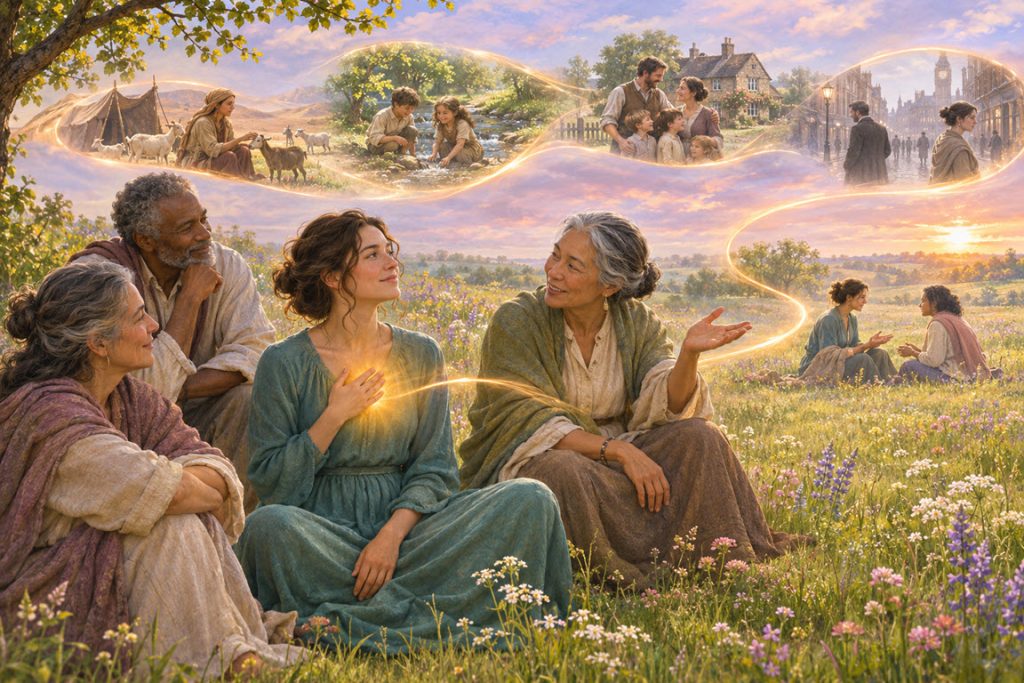
Now we will look at the trajectory of a young woman, Emily, who sought to understand the origin of the pain in her heart. Emily is seated before her Council of Elders. She is deep within Spirit territory, in a regression process that has already taken her through a past life in which she died by her own hand. Emily tells the Council she is experiencing pain in her heart. She believes this pain stems from her attachment to a man she loves. This man, Brian, is much older than she is and is also married. The Council is gathered in what appears to be a bright, open meadow. Emily feels optimistic. She knows she will get the answers she seeks.
Emily asks how she can let go of her powerful attachment to Brian and fulfill her highest purpose. The Council tells Emily that Brian is connected to her purpose, but she must be patient. There are still things to unfold. She asks again about the pain and wants to know what she agreed to do in this life. First, the Council reviews her past-life connections to this man.
A Council Elder speaks: This soul is not a member of your originating soul group. He belongs to a “mate” soul group. You first met about 4,000 years ago in a desert that looks like Saudi Arabia. You were a member of a nomadic tribe that lived in the desert, moving when water sources dried up. The tribe had sheep and goats. You were a small girl when a group of horseback marauders raided the camp dwellings. Their way of life was to plunder and destroy, taking whatever supplies, food, and women they wanted. The man you are currently involved with was a young teen then, and his heart did not truly embrace the violence of this way of life. Nevertheless, it gave him the skills and companionship he needed to survive. The young teen intervened on your behalf, saving your life, and from then on he cared for you. This was the beginning of the love that grew between you, though it was not an easy love. This young man did the best he could to raise you, but it was a hard life for a woman, and you died at an early age, still filled with grief. This is the originating source of the pain in your heart.
In their next life, Emily and Brian met in Oregon in the late 1700s. They were siblings. They were very young when they were playing by a creek and were shot with arrows by an Indian who was angry at the white “invaders” settling in Oregon in greater numbers. As Brian and Emily’s souls departed, they promised to be there for each other the next time they incarnated together.
Emily and Brian meet again in rural England in the early 1800s. Retaining the same gender as before, they marry and spend their lives on a small farm. They have two children – a boy and a girl. They live a happy, though hard, life, caring for each other and their children, and they die in their 50s. They share a strong, loyal connection and support each other in every way. Their heart bond deepens with each successive life they share.
The Elder shows Emily one more life in which she and Brian find each other again, this time in London. Brian is well-off and entitled. Emily is poor and lives outside the city. They occasionally see each other when Emily goes into the city to purchase supplies. When they first meet on the street, they feel a sense of familiarity and are drawn to each other, but they do not act on it. Their interaction consists solely of glances. Emily, ten years younger, would love to approach Brian, but she cannot do so outside an appropriate social context. And given that she is not his equal, the meeting will never happen. With little to do, Brian hangs out in saloons, drinking and gambling. To Emily’s sorrow, Brian eventually marries someone of his social standing. He later dies in a saloon brawl, shot through the chest. Emily sees him in his last moments, as he lies dying in the streets. This life, in which they were forced to keep their distance and couldn’t explore their real connection, added to the pain in Emily’s heart.
Emily and Brian’s hearts were initially connected through circumstances that were deeply painful for her, while Brian also found an opening to compassion despite his warrior-marauder perspective. The plight of the small girl whose parents were murdered offered him the opportunity to rise above the lawless, insensitive ways of his band. As the Elder revealed, Emily’s heart pain around Brian had its origins in that life. After that life, the souls of Emily and Brian saw a spiritual opportunity to apply the lessons of the open heart and decided to explore them by incarnating together. As we can see, the pain in Emily’s heart is complex. It began with great anger towards him for 1) what he did to her desert tribe so long ago, and is also complicated by her appreciation of his efforts to save her life. In summary, Emily’s heart bonds to Brian further include: 2) her love for her little brother, 3) her love for her husband, 4) the unrequited love from the London life, and 5) the current situation in which Brian is not available to live his life with her.
In this trajectory, successive incarnations between Emily and Brian do not necessarily create increasingly stronger connections – at least as we understand them from the level of personality and what most of us would like to see happen. A difficult beginning marked by forced contact follows, in which Emily learns to love her enemy, followed by a series of lives with familial bonding. However, in their most recent lives, they are prevented from sharing the profound affection they genuinely have for each other. Personality would much prefer a story in which the lovers are happily and permanently reunited each time, but the soul – like the heart – has its own logic and, more importantly, its own higher purposes.
Now the Council is ready to answer Emily’s question about why she chose the current incarnation. Don’t you remember? You came here to be a peacemaker. We have told you that the best way to bring peace to this world is to help individuals find it within themselves. You are going through this struggle with Brian so that you can learn peace amid personal turmoil and uncertainty. The best thing you can do right now is stay connected to spirit, trust the process, and be joyful.
Emily is also told that each of their souls is working to manifest their individual purpose. She is told that she needs to commit to the path of joy and love. If she does, her attachment to Brian will diminish as her focus turns more and more to fulfilling her unique soul intentions. She is encouraged to pursue her studies in psychology and meditation. They tell her: Yours is a peacemaking soul; it is also an illuminator of love. Healing vibrations for others emanate from your heart when it is open, and you are following your path. You can express these soul gifts through the venues where you seek to study and work. When Emily asks again about the possibility of a future with Brian, she is reminded to pursue the path of love and joy. Understand that this is the highest way to live your life. The path of the heart is the path of wisdom. The future cannot be foretold; you make your destiny by the choices you make in each moment. The more your choices are informed by your soul’s intentions, the more joy and fulfillment you will have.
Through her incarnations, Emily’s soul specialized in the path of the open heart. An open heart will be broken, but a well-navigated broken heart can create expansiveness that holds space for others’ brokenness. It also teaches, by example, that the gifts of an open heart lead to wisdom and compassion. The cumulative influence of her incarnations created a gentle, approachable personality that others find safe and welcoming. Her successful passage through difficult experiences gave her the insights and tools to show others how they can do the same.
Understand the ways in which we can recognize our soul intentions
Emily’s need to understand the purpose of her current life indicates her desire to align with her original soul intentions. Emily’s natural interests in meditation, psychology, reincarnation, and harmonious connections with others have been persistent and strong this life. Her Council validated that these are areas where she could focus her professional efforts fruitfully. They also observed that while these approaches to fulfilling her purpose are appropriate, she could express her soul gifts in other ways, and suggested she explore this further. In other words, Emily should follow the general warp and weft of what she seeks to accomplish, as this will help her discover additional ways to satisfy her objectives. She will be surprised and delighted to find that the spiritual path she is committed to is richer than she realizes.
“What do I need to do to fulfill the requirements of my intentions, and what is my next step toward getting there?”
Pay attention to the experiences that resonate most with you, as they will help you identify and remember what you agreed to show up for. Pay attention to your emotions, as they will guide you. Let go of the paths not taken and the roads not fully traveled, and begin here: live each day as if it were your calling. Without excessive attention to detail or overthinking, choose the activities that seem most right or important. Instead of demanding immediate results, revel in the quietly unfolding intrigue of each moment. Take small steps, one at a time. You don’t need to offer arguments or resistance; simply take each step, improvising as you go. You do not need to know the next step or the next action – by responding to the choices that call to you, to those impulses that seek expression – your life plan and purpose will reveal itself.
As you faithfully listen to the call of your intuitive knowing, you will become more adept at discerning the next right action. You do not need to wait for inspiration. Simply take actions that best reflect what you know to be true for yourself, and you will steadily regain your footing on your course as you remember your passions, which will reconnect you to your soul intentions.
© | Gloria Constantin | All Rights Reserved |
Need help or have questions? Contact Me
Keep up the fantastic work. I read a few of your articles. Your blog is very interesting, with lots of superb information.
I couldn’t resist commenting. Well written!
Thanks for your marvelous posting! I genuinely enjoyed reading it. You are a great author. My partner and I absolutely love your blog and find nearly all of your posts to be just what I’m looking for. Please keep up the excellent job.
Excellent post. Very useful information, specifically the ultimate section 🙂 I deal with such information much. I was looking for this particular info for a long time. Thanks and good luck.
Thank you so much for this article. I truly needed it. I have been having trouble with my age and the fact that I became aware and awake in my late forties. There are times when I begin to feel that at 51, it is too late for me to throw my whole heart into pursuing my Life Purpose. This article helped me.
I really like it whenever people come together and share ideas. Great website, keep it up!
May I simply just say what a relief it is to find someone who knows what they’re talking about. You know how to illuminate a topic. More people should check this essay out! I can’t believe you’re not more popular, given that you possess the abiltiy to articulate in depth on this topic.
Excellent explanation – thank you.
Very useful information. Why not write a book about this particular subject. Thanks a lot.
I simply want to mention how much I like your website. You amazingly come with impressive articles. Thanks a lot for sharing your website.
Outstandingly illuminating, thanks. It is my impression your current subscribers may well just want a great deal more blog posts similar to this. Keep up the excellent articles.
This is a fantastic write-up with well-scripted, engaging content that is original and holds sensible views. Much within your informative content is in alignment with my way of thinking.